
San Antonio homeowners face a double threat that most U.S. cities don't: intense UV heat that degrades shingles daily, and seasonal hail events that cause hidden impact damage in minutes. Understanding how each threat progresses helps you catch damage before it becomes a structural problem — and before your insurance


Steps
Year 1–5 of heat exposure – San Antonio averages 220+ sunny days per year. UV radiation begins stripping protective granules from asphalt shingles almost immediately. Granule loss shows up in gutters first — the shingle surface slowly turns bare and gray.
Ongoing expansion-contraction cycle – South Texas rooftops regularly reach 150–170°F in summer. Daily heating and cooling causes asphalt to expand and contract repeatedly, eventually cracking the shingle surface and curling edges upward — creating entry points for moisture.
Blistering & Adhesive Failure Mid-life shingle breakdown – Trapped volatile compounds in aging asphalt escape as gases under extreme heat, forming blisters on the shingle surface. Sealant strips that hold shingles down soften and fail, making the entire roof vulnerable to wind uplift even on calm days.
Heat + humidity = accelerated growth – San Antonio’s warm, humid seasons create ideal algae conditions. Heat-damaged shingles with depleted granules are far more vulnerable to algae colonization, which darkens the roof surface, absorbs more heat, and further accelerates breakdown.
Late-stage systemic failure – After years of UV and heat stress, the underlayment beneath shingles becomes brittle and loses its waterproofing capacity. Water vapor migrates into the deck, causing rot and structural weakening — at this point, repair is no longer an option.
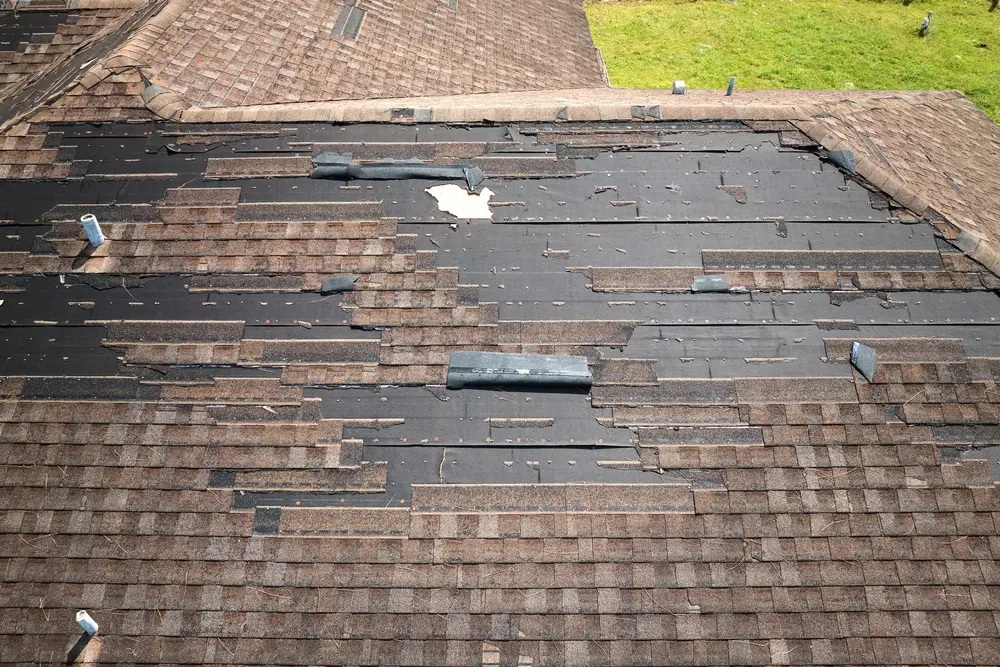
Immediate but invisible damage – Hail as small as 1 inch damages asphalt shingles on impact, fracturing the mat beneath the granule surface. This bruising is invisible from the ground — only a drone or hands-on inspection confirms it — but it begins the deterioration process immediately.
First visible sign post-storm – Impact craters dislodge clusters of granules, leaving bare spots on the shingle surface. San Antonio hail events can strip thousands of granules per shingle in seconds. Displaced granules accumulate in gutters and downspouts after the storm.
Structural surface compromise – Large hail — 1.5 inches and up — can crack shingles outright, breaking through the surface into the mat layer. Cracked shingles cannot seal against rain and create immediate leak risk during South Texas’s heavy spring and fall rain events.
Secondary but critical failure point – Hail dents and lifts metal flashing at valleys, chimneys, and pipe boots — the most common source of post-storm leaks. Adhesive seal strips on shingle edges also break on impact, allowing wind to catch and lift shingles in the next storm.
End result of untreated hail damage – Unaddressed hail damage compounds with each rain cycle. Water infiltrates through bruised mats, cracked shingles, and failed flashing into the attic and ceiling. By the time staining appears inside, structural damage to the deck is already underway.
LOCAL CLIMATE FACTORS
GUTTER FACTS
Sunny days per year in San Antonio — highest UV exposure in Texas
Sunny days per year in San Antonio — highest UV exposure in Texas
Minimum hail size that causes measurable granule loss on asphalt shingles
Faster shingle degradation in high-UV climates vs. national avg.
testimonials
+700 Clients Who Know They Made the Right Choice


 Trustindex verifies that the original source of the review is Google.
 Trustindex verifies that the original source of the review is Google.
 Trustindex verifies that the original source of the review is Google.
 Trustindex verifies that the original source of the review is Google.
 Trustindex verifies that the original source of the review is Google.
 Trustindex verifies that the original source of the review is Google.
 Trustindex verifies that the original source of the review is Google.
 Trustindex verifies that the original source of the review is Google.
 Trustindex verifies that the original source of the review is Google.
 Trustindex verifies that the original source of the review is Google.
GUTTER TIPS